
Bell Resident Lookup Record Map
A resident name has meaning only inside a record's role. An Assessor entry ties an owner to a parcel, a deed names parties to a transaction, and a voter system confirms status only for the person who authenticates or for an approved request. Court, vital, business, license, census, and directory records answer different questions. That distinction keeps a Bell resident lookup useful without turning separate custodians into a made-up roster.
| Record | What It Confirms | Where to Search | Access |
|---|---|---|---|
| Parcel / assessment | Owner connection, situs, AIN, parcel facts | Los Angeles County Assessor Portal | Free address or AIN search; owner offline |
| Recorded deed | Named transaction parties and legal identity of a parcel | LA County RR/CC, Norwalk | Name/year index in person; paid copies |
| Voter status or file | Registration status, districts, and permitted election data | California My Voter Status or LA Elections | Authenticated self-check or purpose-restricted request |
| Superior Court case | Name variants, party role, case, date, and document trail | Los Angeles Superior Court | Case number free; name search and images paid |
| Vital record | Birth, death, marriage, or divorce event evidence | LA RR/CC, CDPH, or LASC | Authorized or informational access; eligibility applies |
| Business or license | Entity, agent, officer, or professional affiliation | SOS bizfile or DCA and boards | Public search; not residence proof |
| Census or directory | Historic household or occupancy clues | NARA and library collections | Public census through 1950; Bell directory run unresolved |
Start with the source that matches the clue. An address can lead to an AIN and then an offline owner inquiry. A case number can lead straight to a court summary. A name with a professional field may lead to a license record, while a family question may call for a vital request or a probate file. When only a name is known, use several narrow searches and compare roles, dates, and places before treating two records as one person.
Note: A parcel owner, deed party, voter, litigant, licensee, and directory occupant are different roles.
Match a Bell Resident Across Records
Same-name errors are the main risk in a one-person lookup. Use the full name and every spelling variant found in a source. Compare a spouse or household link, exact street or ten-digit AIN, occupation or entity, filing date, and repeated neighboring names. A court result that has the right name but the wrong filing location is not a match. A business record with the right name but a different entity role is not a match either.
- Role
- The part a person plays in a record, such as owner, grantor, litigant, voter, agent, or occupant.
- AIN
- The ten-digit Assessor Identification Number, arranged as a four-digit map book, three-digit page, and three-digit parcel.
- Situs
- The physical location of a parcel. It is distinct from a mailing address used for tax correspondence.
- Affiliation
- A filed business, license, or agent connection that does not by itself show where a person lives.
The public Assessor result can supply an AIN, situs, assessment facts, map polygon, and parcel-change clues, but the owner name and mailing address are withheld online. The owner route runs through 888-807-2111 or 213-974-3211, a district counter, or the Assessor contact form's Specific Property path using the address or AIN. An owner may be an LLC or an absentee owner, so the result still needs a second source.
Keep the source trail in a small match note: exact name, record role, address or entity, date, case or document number, and the reason the record fits. That habit matters in Bell because Los Angeles County custodians divide parcel, deed, court, voter, and vital information among separate systems. Never merge records solely because a name is common.
Bell Resident Lookup Costs and Case Years
Bell matters are heard in Los Angeles Superior Court, with the filing location set by case type. Bell has no separate municipal court identified, so local citations and cases route through the county court system. Bellflower Courthouse, at 10025 E Flower Street in Bellflower, lists criminal and small-claims operations. The building is open 8:00 a.m. to 4:30 p.m. on weekdays, the clerk is open 8:30 a.m. to 4:30 p.m., and the phone is 562-345-3300. Use the court locator before assuming a Bell case belongs at Bellflower.
| Search route | Fields | What returns | Cost or limit |
|---|---|---|---|
| Find a Case | Case Number text, required; ACCESS CASE | Public case summary | Free |
| Case Calendar | Case Number text; ACCESS CALENDAR | Future hearings | Free |
| Civil, family, or probate name | Last plus first name, or company | Litigant, case type, filing date and location, case number, image count | Paid; guest or account route |
| Criminal name | Defendant name | Case-number discovery | Paid; guest or account route |
| Case Summary | Case number plus Filing Courthouse dropdown | Civil, small-claims, family, or probate summary | Not the official court record |
LASC reports web coverage of family, probate, and unlimited civil cases from 1983 to the present, limited civil from 1991 to the present, and small claims from 1992 to the present. Older material goes through the Archives and Records Center. Eligible limited and unlimited civil and small-claims images cost $1 per page for pages 1 through 5, then $0.40 per added page, with a $40 maximum per document. Criminal and family documents are not remotely available.
A case result can be more useful than a name alone because it supplies the litigant, case type, filing date, filing location, case number, and number of available images. The case summary may add parties, the filing courthouse, and docket events. A docket is the court's running log of filings and events, not a full copy of every paper in the file.
The official Los Angeles Superior Court case summary interface shows why the case number and filing courthouse should be saved before leaving a search result.
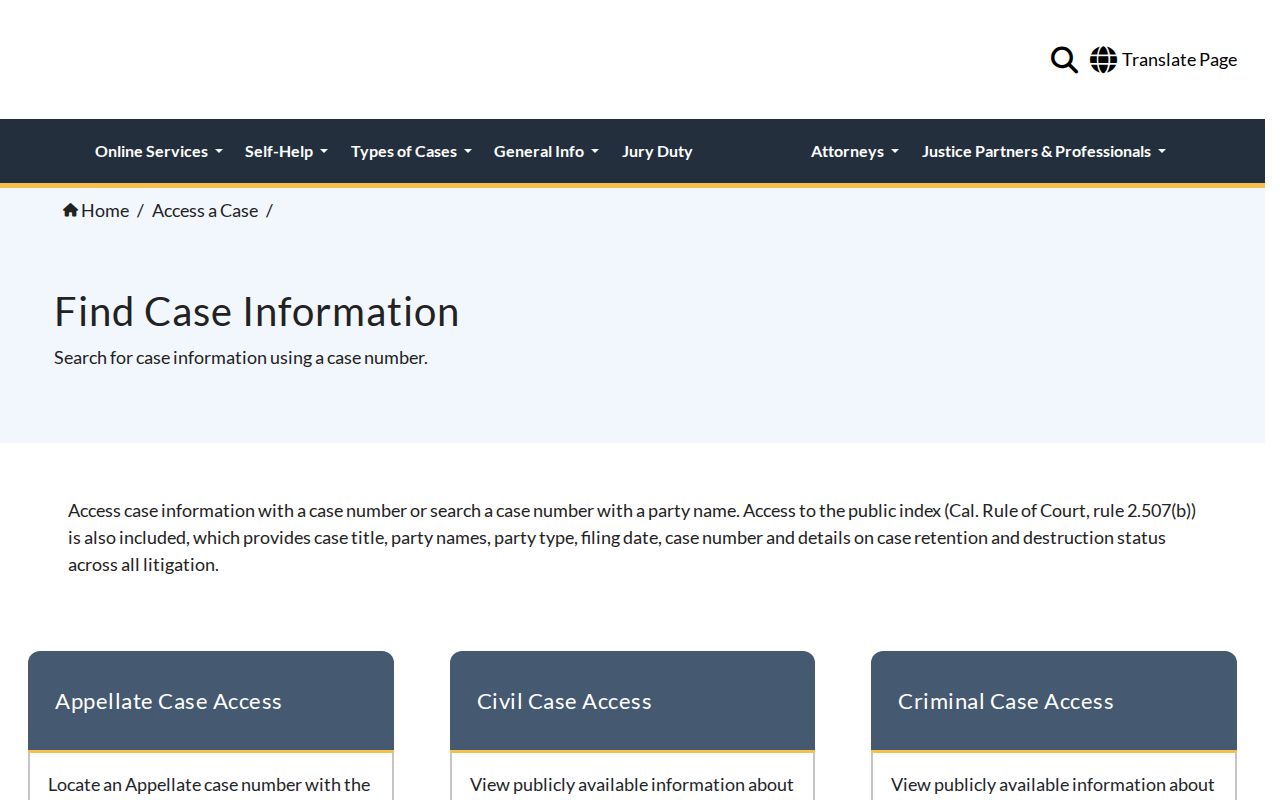
The summary screen is a navigation aid. When a decision depends on the file, request the official record through the filing court or the available records channel.
The Los Angeles Superior Court name-search guidance explains the difference between free case-number access and paid party-name routes.
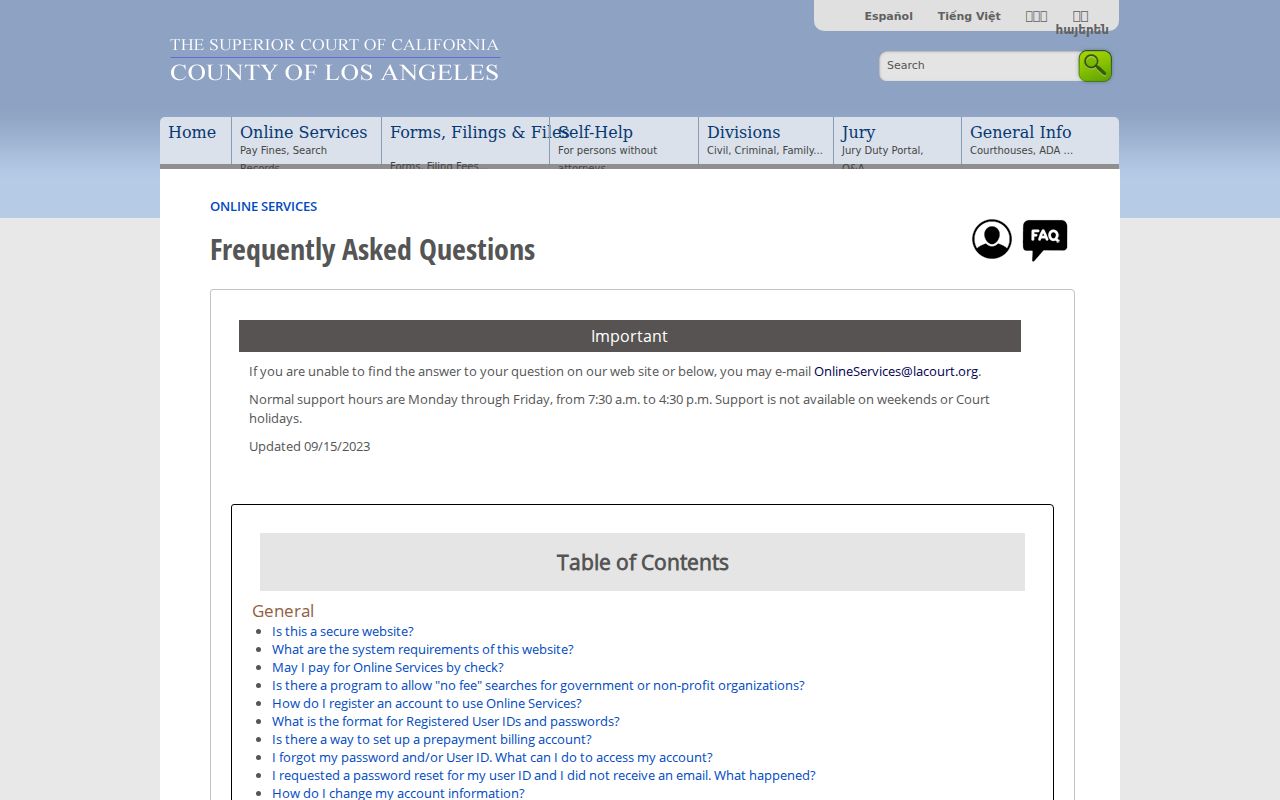
Guest name results last 24 hours, while purchased documents remain available for 30 days. Download paid material promptly. Juvenile, sealed, and adoption records are unavailable, and unlawful-detainer indexes are restricted for the first 60 days unless a statutory condition applies.
Federal matters use a separate path through the U.S. District Court for the Central District of California. Los Angeles public terminals are at 255 E Temple Street, Suite 180; clerk intake is 9:00 a.m. to 4:00 p.m. with a 12:30 to 1:30 closure. Terminal printouts cost $0.10 per page, copies $0.50 per page, certification $12 plus copy fees, and archive retrieval is $70 for the first box plus $43 for each additional box. PACER generally charges $0.10 per page, caps a document at $3, and waives a quarterly bill of $30 or less.
The Central District federal records instructions are the correct starting point for a Bell-connected federal case.
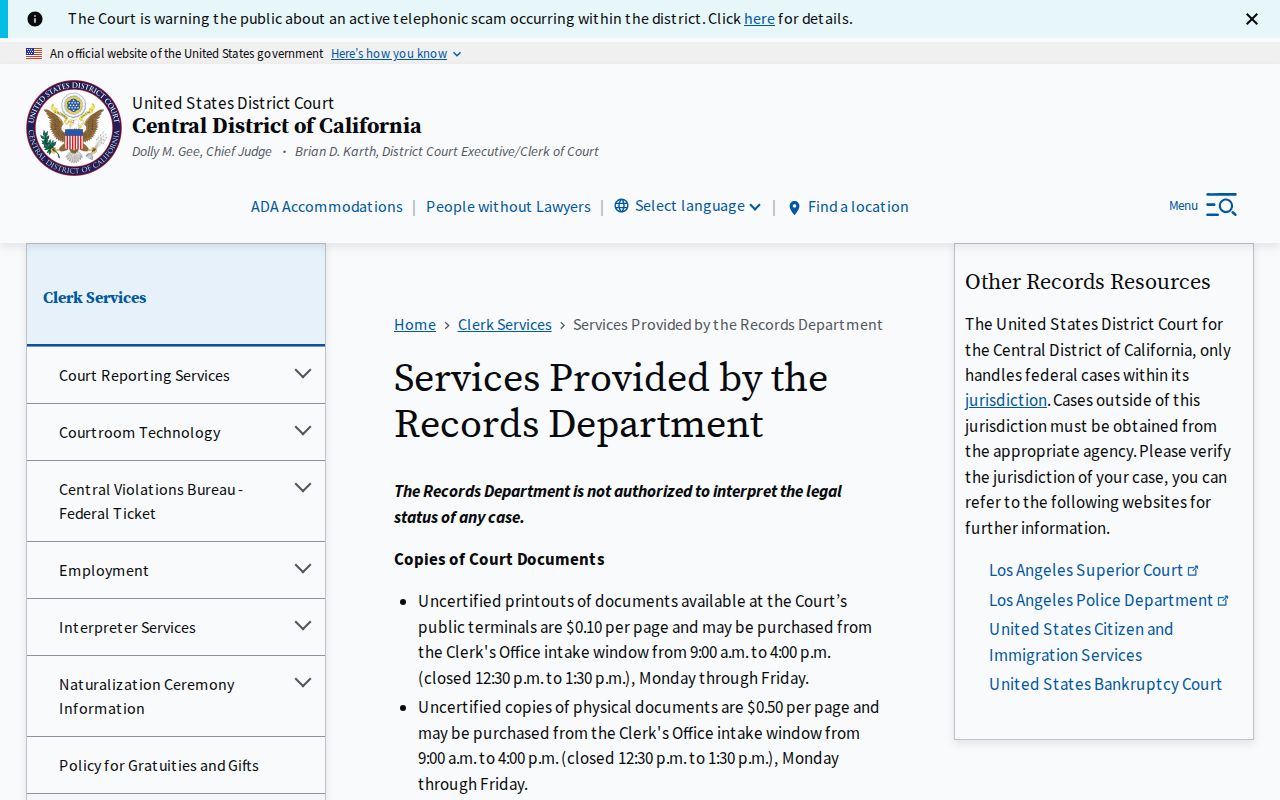
Federal records, county cases, and state criminal-history systems are separate. California DOJ does not provide a public name search of another person's statewide criminal history; individuals can request their own fingerprint-based record review.
Bell Vital Records Need the Right Copy
California vital access is not a simple rule that makes every birth public after 100 years or every death public after 50. Health and Safety Code §103526 separates authorized copies, which can establish identity, from informational copies. A person outside the authorized group may still receive an informational birth, death, or nonconfidential marriage copy when the custodian allows it, but the copy is marked as not valid to establish identity. Confidential marriage copies are restricted under Family Code §511.
For a Bell event, LA County RR/CC and the California Department of Public Health are parallel custodians. County channels cover county events and may be faster. CDPH handles statewide requests and reports an average of 4 to 6 weeks for certified copies and 7 to 9 weeks for amendments. A fee is retained for the search when no record is found.
| Record | Custodian and coverage | Access and timing | Fee |
|---|---|---|---|
| Birth | LA RR/CC since 1866; CDPH statewide | Authorized or informational under H&S §103526; older county periods mailed within 20 business days | County $34; state $31 |
| Death | LA RR/CC since 1877; CDPH statewide | Authorized or informational; older and informational county requests mailed within 20 business days | $26 |
| Nonconfidential marriage | LA RR/CC or CDPH | Authorized or informational copy request | $19 |
| Confidential marriage | LA RR/CC | Not public; parties, court order, or good cause may qualify | County $19 |
| Divorce | LASC decree/file; CDPH certificate of record | Court access rules apply; CDPH does not issue the decree | CDPH $18 |
County birth service is available in person for 1962 to the present, except that 1972 to 1977 may be supplied at an appointment; 1866 to 1961 and 1972 to 1977 are mailed within 20 business days. Death service is in person for 1995 to the present, while 1877 to 1994 and informational copies are mailed within 20 business days. Authorized birth recipients include the registrant, parent or legal guardian, specified relatives, a court-order holder, and an authorized attorney or representative. Death access also recognizes disposition rights and funeral agents acting for them. Mailed authorized-copy requests require a notarized sworn identity statement or qualifying electronic identity proof. Online county ordering through VitalChek adds a handling fee and processes in about 20 working days.
A vital record can confirm an event, not a present address. Check the event place, approximate date, parent or spouse names, and the relationship or authority before paying for a copy. The California vital-record application hub is the safer route than relying on an unverified form copy.
Bell Voter Status, Not a Resident Roster
California My Voter Status is an authenticated self-lookup, not a public name and address browser. The person checking their own record must supply personal match fields. That design makes the tool useful for a resident confirming status while preventing a Bell resident lookup from becoming a street roster.
- First name
- Required text field for an exact personal match.
- Last name
- Required text field for an exact personal match.
- Date of birth
- Required month, day, and year controls used as a personal identifier.
- California DL or ID number
- Conditional text field for an exact match, with a checkbox if none is available.
- SSN last four
- Conditional text field for an exact match, with a checkbox if none is available.
An authenticated voter can see registration status and location, party preference, language preference, polling and election information, and vote-by-mail or provisional-ballot status. Vote history means participation, never ballot choice. Driver-license or ID data, the last four digits of an SSN, signature, and protected fields stay confidential.
Elections Code §§2194 and 18109 restrict voter information to election, scholarly, journalistic, political, governmental, or registration-purpose uses. Commercial use is prohibited, and knowing misuse can be penalized. Government Code §7924.000 protects specified fields. LA County's separate Election Information Section handles certified self records, authorized individual copies, voter history, and file searches. Mail requests call for requester details, signature, and a self-addressed stamped envelope; bulk or precinct files require a statutory-purpose declaration and fee.
That separate request channel matters. An ordinary California Public Records Act request cannot be used to bypass voter-file limits. Safe at Home provides a confidential registration route for qualified participants, so an absent name or address is not proof that a person is absent from Bell.
Bell Business Affiliations in Name Search
State business and professional records can help explain why a name appears in California sources, but they do not turn a filed address into a residence. SOS bizfile searches an entity name or file number, then allows optional filters for entity type or group, entity status, an initial filing date range, and a Begins with match mode. The search is useful when a person is listed as an agent, officer, director, manager, or service contact.
The result inventory can include an entity name and number, formation, registration, or conversion date, status, jurisdiction, tax or SOS standing, street and mailing addresses, agent for service, Statement of Information due date, officers, directors, managers, filing history, and available PDFs. Search and plain recent PDFs are free; a certified copy or status document generally costs $5. SOS cautions that it does not maintain a definitive ownership database. Fictitious business names remain a different RR/CC record set, and a copy request may need a filing number.
The California bizfile business search illustrates the difference between a filed affiliation and a residential finding.
Use the entity number, filing date, and role to distinguish a Bell business connection from a same-name person who has no link to the filing.
The California Department of Consumer Affairs search adds another affiliation check. Its modes can use a board or bureau, license type or number, business or person name, and city, county, or ZIP. Board-specific records may show status, address of record, and public discipline. The address of record belongs to the license record, not necessarily to the licensee's home.
The California professional-license search provides the appropriate statewide starting point for a credential question.
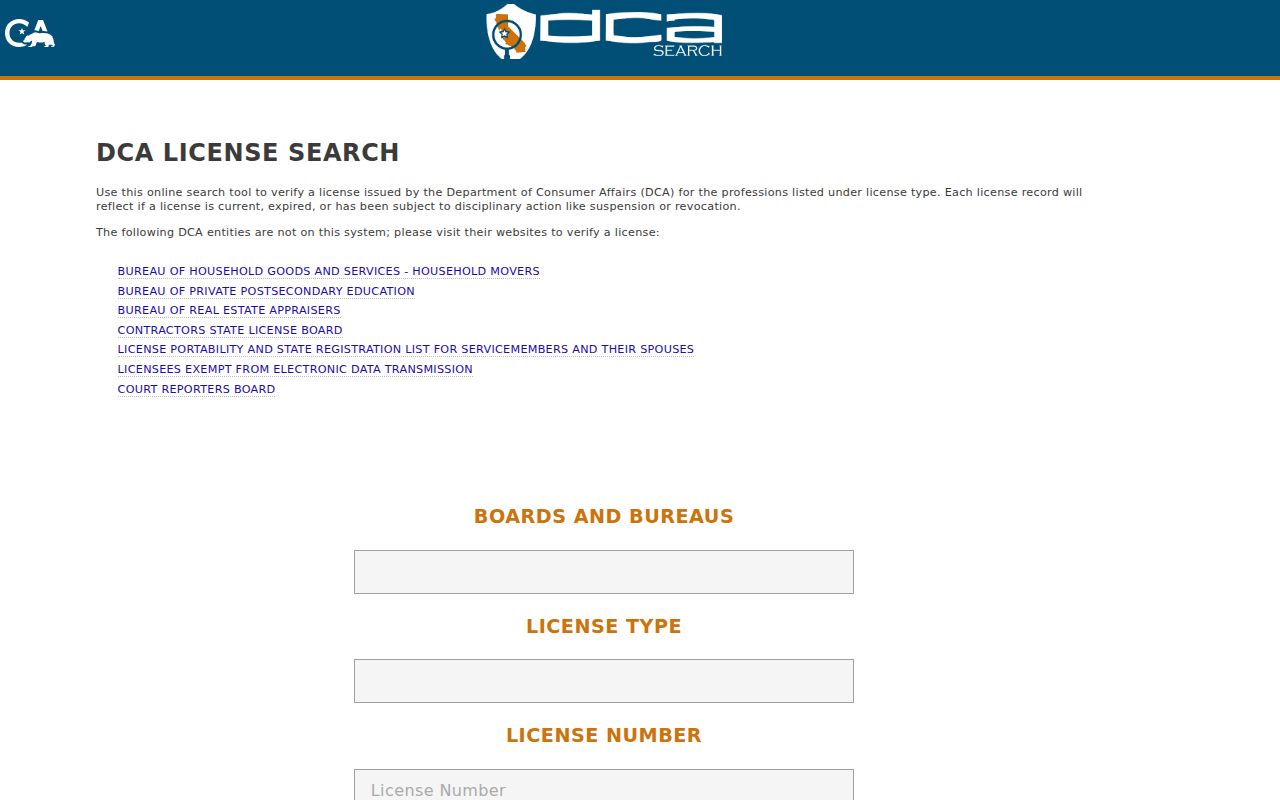
Follow a DCA result to the relevant board before relying on a status or discipline detail. A name, city, or ZIP match still needs an independent record and a clear record role.
Verify One Bell Resident in Sequence
A practical verification task is checking whether a named person connects to a current Bell parcel without confusing ownership with occupancy. The record trail should preserve both the source and the limit at every step. When the address is not known, start with the person's lawful clue, then move to the custodian that can answer the next narrow question.
- Write the identity anchors. Record the full name, spelling variants, known street, spouse or household clue, occupation or entity, and any case or event date. These details keep common names apart.
- Convert address to parcel data. Search the Assessor by street address or ten-digit AIN. Save the situs, AIN, map result, and any parcel-change clue. The public result does not expose the owner or mailing address.
- Confirm the owner offline. Use the Assessor phone, district counter, or Specific Property contact path with the AIN and address. Treat a supplied mailing address as correspondence evidence, not proof that the owner occupies the parcel.
- Test the deed trail. Take the owner name and a recording year to the LA County RR/CC Norwalk index. The grantor and grantee index is arranged by name and year, not by street or APN. Request a complete copy when the document number and legal description fit. If travel is not possible, a mail request needs the document title, names, and recording year or years and can take up to 20 working days; telephone staff do not conduct index searches.
- Cross-check a second custodian. Use LASC for a case number and filing location, a vital record for an event, or a self-authenticated voter result for the person checking their own status. Stop at sealed, juvenile, adoption, confidential, or protected material.
- Docket
- The court's running log of case filings and events. It is not the full official file.
- Index versus image
- An index points to a record; an image is a view or copy of a document and may have separate access or fees.
- Certified copy
- A custodian-issued copy with certification for an authorized use. An informational copy does not establish identity.
- Legal description
- The lot, block, tract, or other parcel identity used to test whether a document concerns the same land.
The sequence is address to AIN, AIN to owner, owner plus year to deed, and deed or case clue to an independent event record. If one step fails, change the custodian or the search key rather than widening the search into a list of people.
Bell Lookup for Heirs, Classmates, Ancestors
A resident lookup often starts with a human question. For an heir, begin with the probate case and the decedent's death record, then inspect petitions or notices only to the extent court access allows. For a former classmate, ask Bell Library for a school and year-specific yearbook check. No verified Bell digitized yearbook holding was established, so the library request should ask for the title, year, format, location, and any copying limits instead of assuming an online result.
Immigrant-family research uses a different chain. Pair the 1950 and earlier federal census with nearby directory or newspaper clues, then use NARA Riverside for federal, immigration, naturalization, or military records. A census citizenship answer is a lead, not conclusive proof. The National Archives census research guidance explains the federal holding and the 72-year public-access rule.
Bell Library, at 4357 E Gage Avenue, can provide in-person and telephone research help at 323-560-2149. Staff can also direct a request toward the LA County Library catalog or the Norwalk Californiana collection. Directory years, publishers, reverse sections, obituary indexes, and yearbook holdings remain local research gaps. A careful request should ask staff to verify the exact volume before a directory entry is used as evidence.
California's official adoption and birth-parent processes are confidential. Public court, business, license, or voter material is not a shortcut around those rules. A family search is strongest when it preserves the source's role, date, and access limit rather than treating every name hit as a current resident.
The California Controller's unclaimed-property search can add a narrow name clue when a reported property match exists, but a property report is not proof of residence. The California unclaimed-property name search is a free lead that still needs custodian verification.
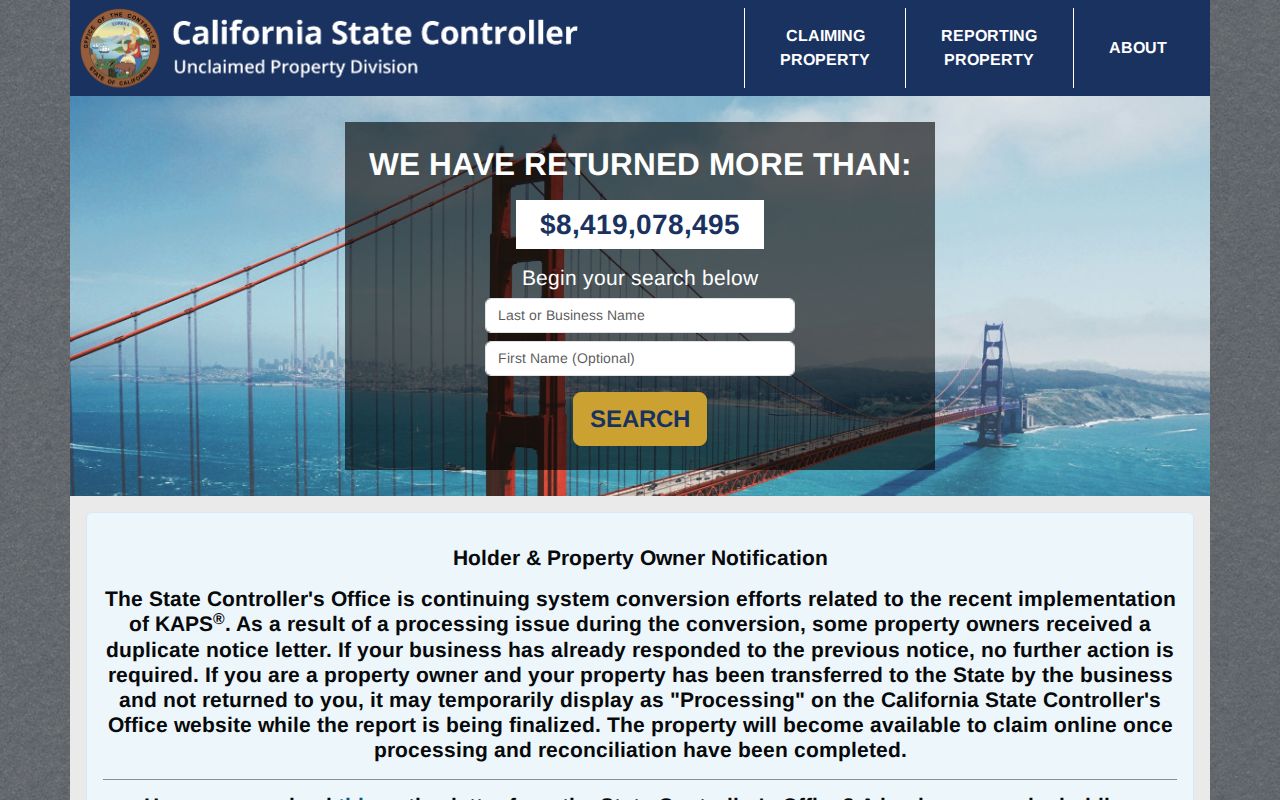
A reported-property result may reflect an old address, an heir, or a business relationship. It belongs in a research note, not in a claim about where a Bell resident lives now.
Bell Records and Privacy Limits
Public access has boundaries. California's CCPA and CPRA rights cover covered businesses, while voter, vital, court, motor-vehicle, utility, and address-confidentiality rules apply to their own record sets. Safe at Home gives qualified survivors and threatened participants a substitute mailing address, mail forwarding, an agent for service, and confidential voting. It is not witness protection and does not erase identity. Government Code §6209.5 supports substitute-address use on qualifying real-property documents.
California's DROP system began centralized data-broker deletion requests on January 1, 2026. Registered brokers began processing on August 1, 2026, with matching and deletion on rolling 45-day cycles. A resident can submit one verified request through the California DROP request system, retain the confirmation, and recheck later. That opt-out process addresses covered broker data; it does not change a court file, a deed, or a lawful custodian's record.
Lawful personal use. A Bell resident lookup is for lawful personal research, family history, civic verification, or a specific records need. Do not use records to stalk, harass, intimidate, or cause unwanted contact. California stalking and electronic-publication laws can create criminal or civil consequences.
When an official portal stops, make a narrow request to the record keeper. Bell City Clerk's California Public Records Act form asks for a requester name, mailing address, email, telephone, a reasonable record description, optional comments, and CAPTCHA. Bell treats a request filed after 5:00 p.m., on a weekend, or on a holiday as received the next business day. The clerk states a 10-day determination period and a possible written 14-day unusual-circumstances extension.
The Bell City Clerk public-records request form is the fallback for a focused municipal file, such as a permit or civic record. Ask for an exact address, AIN, record category, and date span. A CPRA request cannot override sealed court records, confidential marriage access, protected voter fields, Safe at Home data, or other statutory exemptions.
Note: A no-result can reflect a spelling variant, date gap, different custodian, sealed record, or protected address, not proof that a person or record does not exist.