
Bell Sources for a House's Previous Residents
Past residents of a Bell address appear in separate record layers. A deed trail names parties to a transfer, while a census schedule or directory may place a household at a location. The May 1922 Sanborn set adds a building check, and Bell municipal files add a later civic record layer. Keeping those roles apart prevents a recorded owner from being treated as the only person who lived at the address.
| Source | Years It Covers | Where Held | What It Shows |
|---|---|---|---|
| Recorded real estate | Mail corpus 1850-present; viewing 1851-present | Los Angeles County RR/CC, Norwalk | Named parties, instruments, recording dates, legal descriptions |
| Physical deed indexes | 1851-1957 lower level; 1958-present second floor | RR/CC Norwalk | Grantor, grantee, and recording-year discovery |
| Federal population census | Through 1950 public; 1960 due in 2032 | National Archives and research partners | Households, relationships, addresses, and occupations |
| Bell Sanborn map | May 1922, 20 sheets | Library of Congress, online | Building footprint, structure, and recorded use context |
| Bell municipal records | November 7, 1927 onward | City Clerk and Community Development | Permits, plans, inspections, and civic files when released |
| Directories and criss-cross volumes | Exact Bell years unresolved | Bell Library or Norwalk Californiana inquiry | Potential address-to-occupant bridge after volume verification |
Start with the source that matches the question. For title history, use the Assessor to convert an address into an AIN and request the owner through the county channel, then take the name and year to the recorder. For household history, preserve the exact address and seek a verified census or library volume. For structure history, compare the Sanborn sheet with the parcel and legal description. Los Angeles County deeds, census entries, and directory listings each supply a different kind of evidence.
Note: A Bell parcel, deed party, directory entry, and voter record describe different roles and should never be merged on name alone.
Begin Bell Previous Residents With a Parcel
The current address is the best starting key. The Los Angeles County Assessor Portal accepts a street address or a ten-digit Assessor Identification Number, called an AIN. Its public result can show the situs address, AIN, assessment characteristics, value panels, parcel-change or ownership tabs, map polygon, and effective date. The public web result deliberately omits the owner's name and mailing address, so it cannot produce a simple list of Bell residents.
| Assessor control | Type | Required | How it helps |
|---|---|---|---|
| Basic Search / Legal Search | Tabs | No | Alternate search modes |
| Search by AIN or Address | Autocomplete text | One value | Ten-digit AIN or street address |
| Map Search | Button and map | No | Zoom, pan, and select a parcel |
Use the Los Angeles County Assessor Portal for the first parcel pass, then request the owner through 888-807-2111, 213-974-3211, a district counter, or the Assessor contact form's Specific Property route. Include the AIN and full address. The AIN is built from a map book, page, and parcel sequence. It is a stronger bridge than a changing street label, but it still identifies land rather than the people who occupy it.
Tax-payment history is a separate AIN lookup and covers the last three fiscal years. It can add a time marker for the parcel, but it does not identify a household. Check the parcel-change information when an older AIN fails, and ask the Assessor when a typed address and map result do not agree.
Bell's Norwalk Recorder Floors
The Los Angeles County Registrar-Recorder/County Clerk is the custodian behind the deed trail. Its real-estate index is not searchable online, by street address, or by APN. Norwalk arranges the physical grantor, grantee, and recording-year indexes by time period, so a previous-residents search must arrive with names and a bounded year range. The county landing page is the official starting point for the records office that holds Bell's recorded instruments.
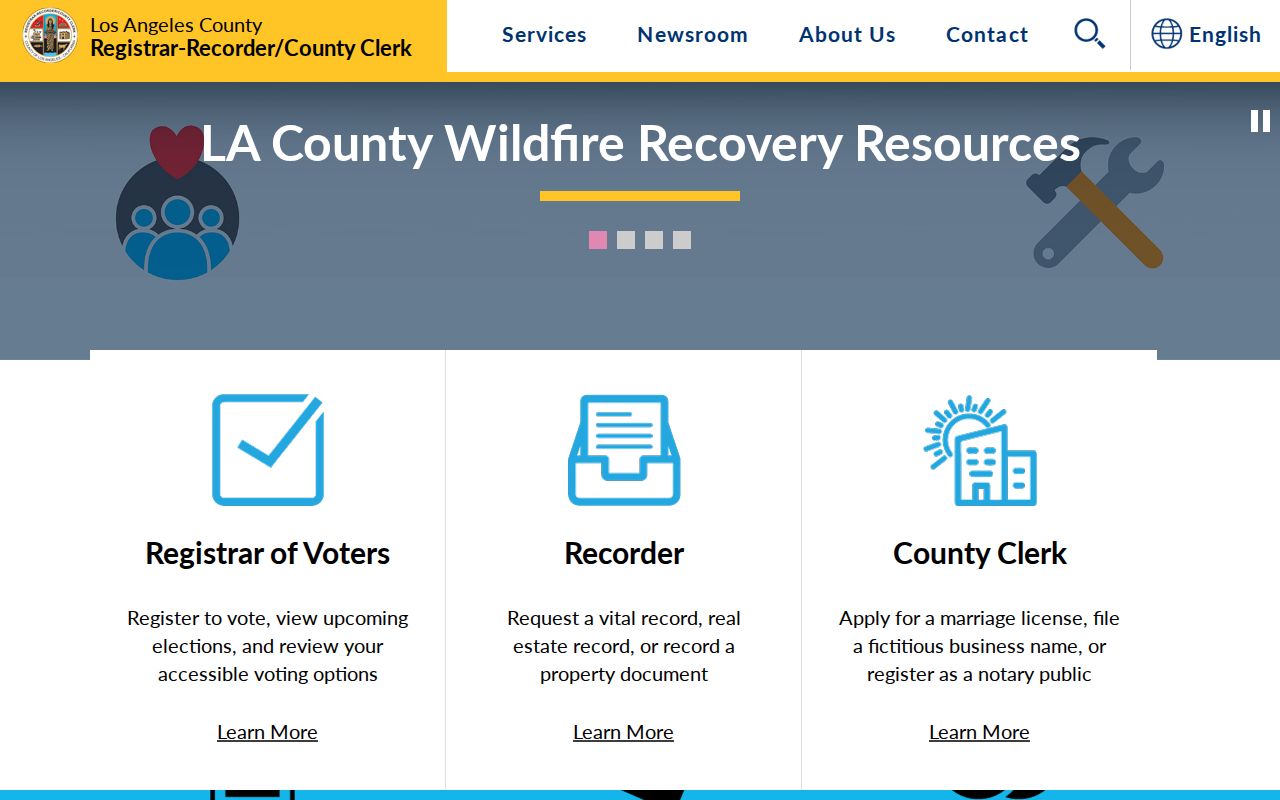
The physical arrangement matters. Indexes from 1851 through 1957 are on the lower level, while indexes from 1958 forward are on the second floor. That split is a Norwalk access fact, not an online imaging cutoff. A name can lead to a deed, deed of trust, lien, notice, plat, or another recorded instrument, but the instrument still needs to be read against the parcel's legal description.
Mail is a fallback when a trip is not possible. RR/CC mail request instructions call for the document title, every known party name with spelling variants, an exact or bounded recording year, and a document number when one is known. Add the requester's contact and return address, plain or certified copy choice, payment, and delivery method. Processing may take up to 20 working days, and telephone staff do not conduct index searches. The published copy and index fees make a long chain worth planning: an index search is $0.50 per name per year, with a $1 minimum, and the search charge is nonrefundable; a plain copy is $5 for the first page and $3 for each additional page, and a certified copy is $6 for the first page and $3 for each additional page. Credit-card service and expedited delivery can add separate charges.
Note: A recording-year cutoff describes index organization, not the date when a Los Angeles County deed was created or preserved.
Trace Bell Previous Residents Through Deeds
Deeds create the ownership backbone for an address history, but they do not by themselves prove who slept, ate, or stayed at an address. The backward move is a name-and-year exercise. Start with the current owner supplied through the Assessor channel, find that owner's acquisition as grantee, then carry the seller's name backward as a new search target.
- Record the street address, AIN, situs address, and any available legal description. Keep the exact spelling and parcel identifiers together.
- Request the current owner through the Assessor's phone, counter, or Specific Property contact route. The public parcel page is not the owner-name search.
- At RR/CC Norwalk, search the current owner as grantee in the likely recording year. Note the document number, recording date, grantor, and legal description.
- Search that grantor as grantee in an earlier year. Compare the legal description and parcel clues before treating the document as the same chain.
- Repeat the seller-to-buyer move backward, changing floors at 1958 and using county or townsite sources when the trail reaches Bell's pre-incorporation period.
- Grantor / grantee
- The grantor transfers an interest; the grantee receives it. In a purchase deed, the seller is usually grantor and the buyer grantee.
- Chain of title
- A linked sequence of recorded transfers for one parcel, checked from one legal description to the next.
- Legal description
- The formal lot, block, tract, or similar land identity used to distinguish a parcel when a street label changes.
- Situs address
- The physical location assigned to the parcel. It differs from a mailing address used for tax correspondence.
The county recorder office information is useful when preparing for the counter search.
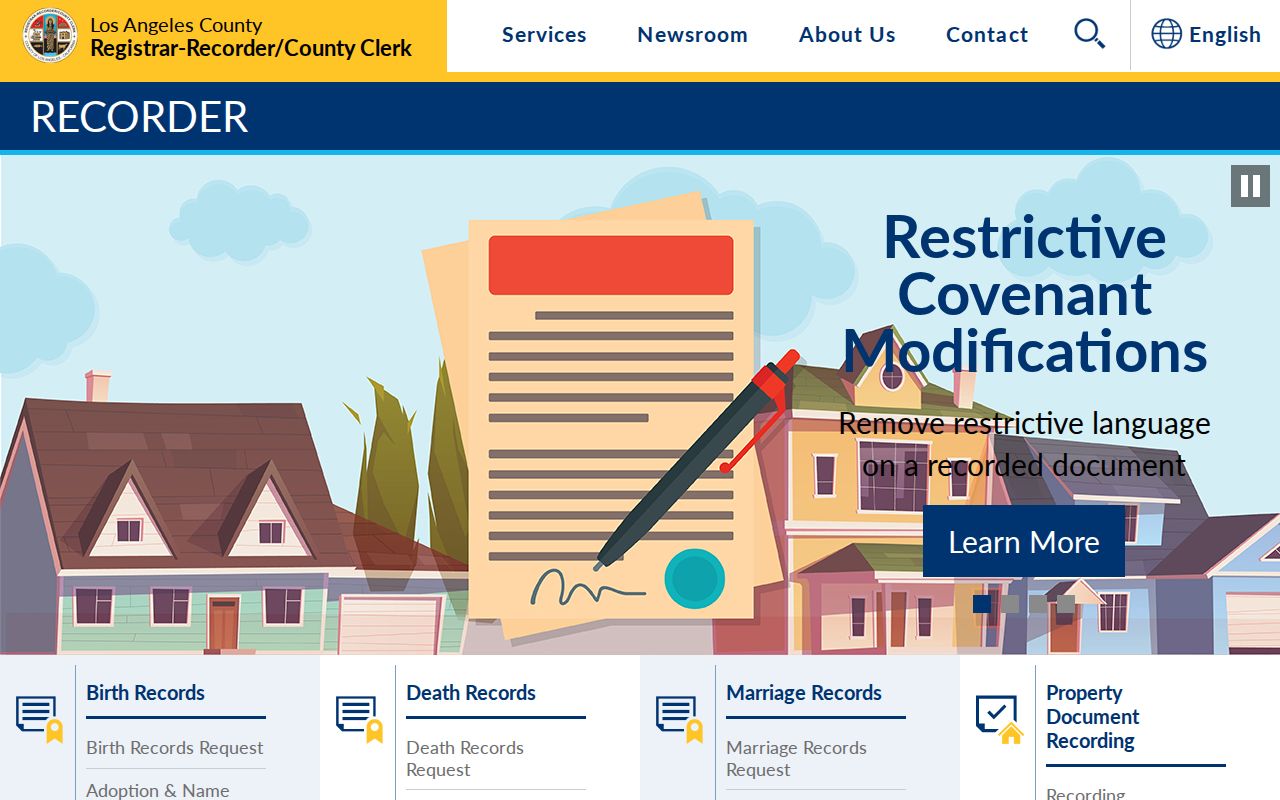
The office image belongs beside the practical rule: carry names and years to Norwalk, then use the legal description to test whether a promising record concerns the Bell parcel. The recorder cannot turn an address or APN into the first name in the chain.
Bell Before City Incorporation
Bell incorporated on November 7, 1927. Before that date, an address in the future city did not have a Bell municipal permit file or city clerk trail in the modern sense. Earlier ownership belongs chiefly to Los Angeles County deed, subdivision, and townsite history. The county record system therefore matters even when the search question is about a house that now sits inside Bell.
The land history reaches farther back. Bell was part of Rancho San Antonio, associated with Antonio María Lugo in 1810. Ranch portions transferred to James George Bell in 1876, and later sales led toward townsite development. Those milestones provide context for why a pre-1927 search may use county instruments rather than city records. They do not identify a particular former household without a parcel and a record.
For later years, the Bell City Clerk preserves municipal files, while city building, planning, and code-enforcement staff handle related channels. No stable public permit search was verified. Ask for a specific permit, inspection card, plan, certificate, or code case by address, AIN, record type, and date span through staff or the city's public-records process. Such material can show an applicant, owner, contractor, or change to a structure, not residence by itself.
Bell Past Households in Census and Directories
Ownership is only one part of a house history. Federal population census records are public through 1950, with the 1960 census due for public release in 2032. The Bell Library at 4357 E Gage Avenue offers in-person and telephone research help, photocopying, and a local starting point. Posted hours inspected were Monday through Friday, 10 a.m. to 6 p.m.; a renovation or Express Library message was present, so call before visiting.
The LA County Library Californiana Collection is held in closed stacks at Norwalk Library. It contains more than 24,000 books and more than 200 newspaper and magazine titles in paper or microfilm. The Bell city directory collections need careful treatment because exact Bell publisher and year runs, reverse-directory runs, and a sample Bell entry were not established online. Use the catalog and ask staff to verify a volume rather than relabeling a Los Angeles city book as a Bell directory.
- Begin with the 1950 census and copy the exact spelling, house number, household members, relationship clues, occupation, and nearby households.
- Ask Bell Library or Norwalk staff to verify a directory or telephone volume's title page, geographic coverage, publisher, inclusive years, format, and any reverse or criss-cross section.
- Step through the nearest verified years and record first and last appearances at the address. Mark every change instead of smoothing gaps into a single household.
- Compare the address and neighbors with the 1922 Sanborn sheet when the structure is old, then keep the census and directory evidence separate from the deed chain.
- Use National Archives census guidance for federal holdings and NARA Riverside as the regional federal-record fallback.
A directory is an occupancy clue, not proof of ownership. A census is an enumerated snapshot, not a current address check. For a careful household timeline, place each entry beside its source year, exact address, and role, then use the legal description only for the ownership question.
Note: Bell Library hours and renovation status were inspected in August 2026, so call before making a research trip.
Bell Previous Residents and Sanborn
The Library of Congress holds a May 1922 Bell and Maywood Sanborn set with 20 sheets. The digitized Sanborn record can show a building footprint, construction context, and recorded use near the time of the map. That makes it a strong story layer for a previous-residents search: it helps answer whether a structure stood there and what kind of space the map described.
The map is not a household register. It does not establish a deed, name every occupant, or prove that a person lived in the structure. Check the sheet and place label carefully because the item also includes Maywood. Then compare the footprint and street pattern with the Bell parcel, the 1950 census, and any library-confirmed directory entry. If the building changed, note the change instead of forcing an old address into a current shape.
Bell's local chronology gives the Sanborn layer extra value. The library system's Bell branch began in 1913, the map dates to 1922, and city records begin after incorporation in 1927. Together, those milestones mark a transition from county and regional evidence to a later municipal record trail.
Human Uses for Bell Previous Residents
Family history is the most useful reason to trace former residents. The practical question is often simple: who lived here before? A researcher may want to understand when a family reached a Bell address, which household members appeared together, or how a property changed before a relative's known date. The strongest path pairs a 1950 census household with nearby verified directory years, a Sanborn building check, and a deed chain that is labeled as ownership evidence.
A former classmate or community connection calls for a different source question. Bell Library staff may know whether a year-specific yearbook or local collection exists, but no authoritative Bell digitized yearbook holding was verified. Ask for the school, approximate year, and collection location. Do not treat an unverified name match, an old mailing address, or a business affiliation as proof that two records describe the same person.
House history can also support an heir search or a family reunion. Start with a deceased person's name, approximate date, and last known place, then use an obituary as a lead and a probate file or death record as a separate endpoint. The name, date, and parcel should agree before a former household is added to the timeline.
Lawful house history. Bell address-history research fits family history, genealogy, property history, and personal curiosity. Do not use names, old addresses, or record clues to stalk, harass, track, or harm a living person.
Bell Directories Show Occupancy
The exact Bell city-directory and criss-cross year runs remain unresolved. No actual Bell entry was available for inspection, and no verified publisher sequence should be stated as fact. Generic directory conventions can guide a library request, but they are not a substitute for checking the title page, coverage statement, abbreviation key, and an actual Bell listing.
When a verified volume is found, treat its role narrowly. A directory may place a name at an address and may include an occupation or household status mark, but a listing usually describes presence or contact information, not title. A recorded deed can identify a grantor and grantee without showing who slept in the home. A census can show a household on the enumeration date without proving ownership. The three sources become useful together only when their dates, address, and name variants line up.
Search names with care in Bell's multilingual setting. Spanish surnames may appear with or without a maternal element or diacritics. Arabic names may use more than one transliteration. Test variants against address, household, and date evidence, and never merge a namesake because the spelling looks close.
Note: Exact Bell directory and criss-cross years remain unverified; ask for title-page coverage before citing a volume.
Bell Previous Residents: Obituaries
When a former resident's trail reaches death, a vital record can anchor the date while an obituary supplies names, relationships, or a last-known place. The Los Angeles County death-record request instructions describe the county's in-person and historical handling.
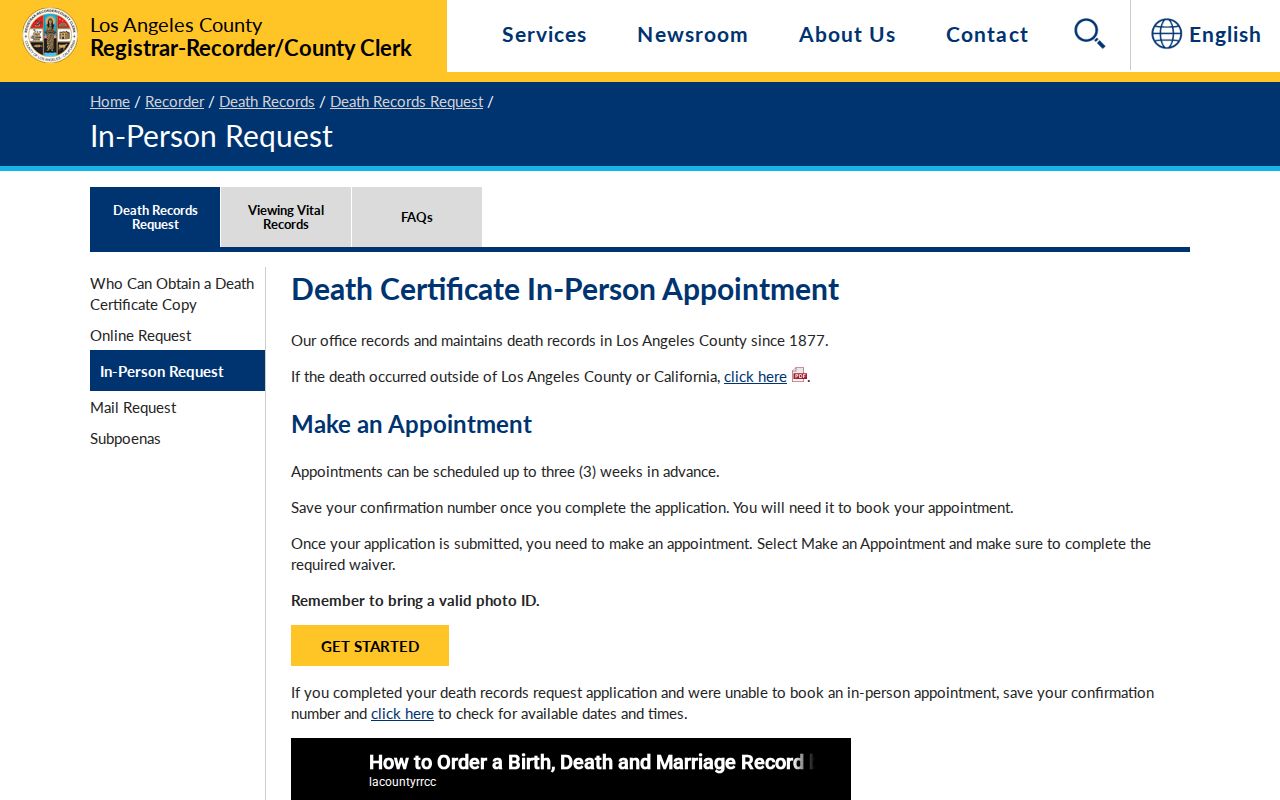
The county death series reaches back to 1877. In-person service covers 1995 forward by appointment, while older records and informational copies use the mail route within the stated processing window. Norwalk inspection requires an identified record, and random searches are not allowed. Eligibility and the authorized-versus-informational distinction matter, so a search clue is not the same as an identity-valid copy.
Probate is a court endpoint, not a recorder or library index. The Los Angeles Superior Court case search reports Family, Probate, and Unlimited Civil coverage from 1983 forward, with older material routed through the Archives and Records Center. Case-number access is free, while party-name discovery and eligible images can cost money. There is no verified Bell obituary index in the research set. Use an obituary as a lead, probate as a court file, and a death certificate as a vital record, with each role stated plainly.
Bell Previous Residents and Legal Descriptions
No official Bell street-renumbering project was found, so address continuity remains unverified. Keep the AIN, situs address, recording date, document number, and legal description together for every deed. If an old street number stops matching, the legal description can still connect a lot, block, or tract to the parcel. The AIN's map book, page, and parcel parts provide another check, but a failed AIN search should prompt a look at parcel-change information rather than a guess.
Mailing address and situs address are not interchangeable. A situs is the physical parcel location; a mailing address is where correspondence may be sent. Neither one proves who lived there. When a map and typed address disagree, preserve both results and ask the Assessor for clarification. When a deed and directory disagree, label the deed as ownership evidence and the directory as occupancy evidence.
A finished Bell previous-residents timeline should name the source, year, address form, and record role for every entry. County deeds carry the backward title chain. Census and verified directories carry household clues. The Sanborn set supplies structure context. Obituaries and probate can close a deceased resident's trail. That disciplined separation makes the history useful without turning an old address into a claim about a living person.