
How Bell Residents Are Found
No single roster answers every resident question in Bell. The trail crosses city, Los Angeles County, and California custodians. Each one holds a different slice. A parcel search ties an address to an Assessor Identification Number, or AIN. The county deed index names the parties to recorded instruments. Voter status works only as a private self-check, never as a street list. Court and vital records supply event evidence. Library, census, and map collections cover older households.
Let the clue in hand pick the first source. An address points to parcel facts. A registration question points to My Voter Status. Ownership questions lead to the Assessor and then the Registrar-Recorder/County Clerk. Family-history work may need the 1950 Census, Bell Library staff, or the May 1922 Sanborn map. The sequence keeps those roles separate. Each record answers a narrower question than the phrase "residents directory" suggests.
- Start with the Los Angeles County Assessor Portal by Bell address, AIN, or map, knowing that the public result does not show the owner name.
- Use California My Voter Status only for the authenticated voter, with the exact name, birth date, and required identifier.
- For property history, take a known owner name and recording year to the Registrar-Recorder/County Clerk (RR/CC) grantor-grantee index in Norwalk.
- For a case or life event, use the Los Angeles Superior Court or the appropriate county or state vital-record channel.
- For an older household, ask Bell Library or the National Archives (NARA) for the relevant collection, then make a focused city request for records not exposed online.
Bell Resident Records Offices
Three desks anchor any Bell residents directory search. The Bell City Clerk keeps municipal files and takes public-records requests. Los Angeles County holds the Assessor's parcel trail and the Recorder's real-estate instruments. Elections staff handle authenticated status checks and purpose-restricted voter requests. None of the three keeps a complete household list.
Bell City Clerk
6330 Pine Avenue
Bell, CA 90201
323-588-2611
Monday-Friday, 8:00 a.m.-4:00 p.m.
LA County Recorder / RR/CC
12400 Imperial Highway
Norwalk, CA 90650
800-201-8999
Office index, counter viewing, and mail copies
LA County Elections
12400 Imperial Highway, Room 2013
Norwalk, CA 90650
800-815-2666, option 4
My Voter Status and county request channels
Bell City Hall opens Monday through Friday during the hours listed above. The Clerk's office also offers a help email and a Laserfiche records portal. Norwalk serves as the county access point for the office-only real-estate index. Elections requests follow a separate identity and purpose process. The Assessor Portal is the quick web step for an address or AIN. Owner information still takes an offline county route.
Starting a Bell Address Trail
An address is the strongest opening clue for a Bell parcel, but it is not proof of who lives there. Enter the street address in the Assessor Portal. Record the ten-digit AIN and the situs. Save the parcel facts before moving to another custodian. The street-by-street chain belongs with the Bell street directory workflow, where adjacent parcels and address evidence get fuller treatment.
The order matters. The Assessor web search runs on addresses, while the RR/CC index runs on names and years. An owner may be an entity or an absentee. An occupant may never appear in a property file at all. A permit, tax payment, deed, census entry, or directory line can add context, though each carries a different evidentiary weight.
- Resident roll
- A broad phrase for a record set that may identify people, parcels, or households; Bell has several partial rolls rather than one master list.
- Parcel
- A defined piece of land tracked by the county, usually through an AIN and legal description.
- Situs address
- The physical location assigned to the parcel, distinct from a mailing address used for correspondence.
- Grantor and grantee
- The transferor and recipient named in a recorded instrument; these roles do not by themselves prove residence.
- Criss-cross directory
- A reverse directory organized by address or street, useful for historical leads when a verified Bell volume exists.
- Index versus image
- An index points to a record; an image or certified copy is the underlying document and may require a separate fee or eligibility check.
Why Bell Deeds Stay in Norwalk
The Los Angeles County RR/CC viewing instructions reveal the local quirk. Bell deeds have no internet index. The office cannot search its real-estate records by street address or Assessor Parcel Number. At the public counter, searches run through alphabetical grantor, grantee, and recording-year indexes. Material from 1958 to the present sits on the second floor. Records from 1851-1957 sit on the lower level.
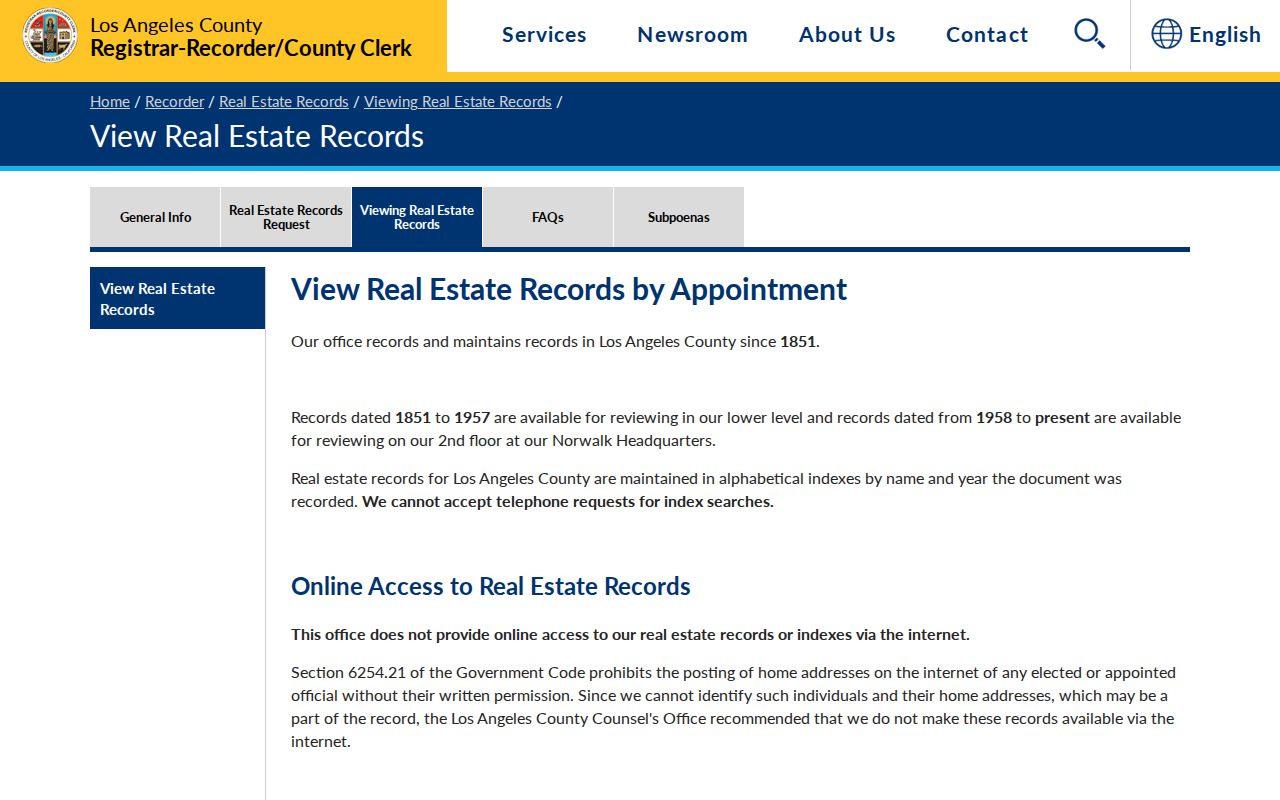
The mail corpus reaches back to 1850, and counter viewing begins in 1851. A mail request needs the document title. It also needs the party names and the recorded year or years to search. Processing can take up to 20 working days. RR/CC prices a plain copy at $5 for the first page. Each added page costs $3 more. A certified copy runs $6 plus $3, and an index search at $0.50 per name and year with a $1 minimum. A copy shows the instrument date, named parties, APN, return address, and legal description.
For a Bell ownership trail, search the current owner as grantee first. Then name the seller as grantor and repeat in an earlier year. Keep the legal description with every step, since address labels drift. Remember what the chain proves: recorded transactions, not a full list of past occupants.
Current Bell Resident Directories
Current records resemble a directory only when the question stays narrow. The Assessor locates a parcel. My Voter Status shows the authenticated voter's registration and polling details. Recorded instruments identify parties to a transaction. Bell's Clerk and staff files point to civic records and public contacts. None of these amounts to a complete list of everyone living in Bell.
| Source | What It Can Show | Keeper | Access |
|---|---|---|---|
| Assessor parcel search | AIN, situs, assessment and parcel traits | LA County Assessor | Free web search; owner offline |
| My Voter Status | Authenticated registration, districts and election details | California Secretary of State (SOS) | Self-lookup with identity fields |
| RR/CC recording index | Grantors, grantees and recorded instruments | LA County RR/CC | Norwalk counter or mail request |
| City Clerk and Laserfiche | Agendas, minutes, ordinances and selected city files | City of Bell | Web PDFs, Clerk help, or CPRA request |
| City staff directory | Public officials, employees and department contacts | City of Bell | City web and staff contacts |
Use the property trail for land, and the voter tool for your own registration. The RR/CC covers recorded parties, and the Clerk handles municipal action. A name match alone proves little. Anchor it with a date, household, street, AIN, or entity. That separation keeps a business address or an absentee owner from masquerading as a current Bell resident. A same-name court result fails the same test.
Bell Assessor Search Fields
Most parcel work in Bell starts with the Los Angeles County Assessor Portal. The site is straightforward. Basic Search and Legal Search tabs handle an AIN or address lookup. Map Search adds a visual layer for picking parcels. One limit matters here. The public version of the tool hides owner names. An address match is never a person match in this county assessor resource.
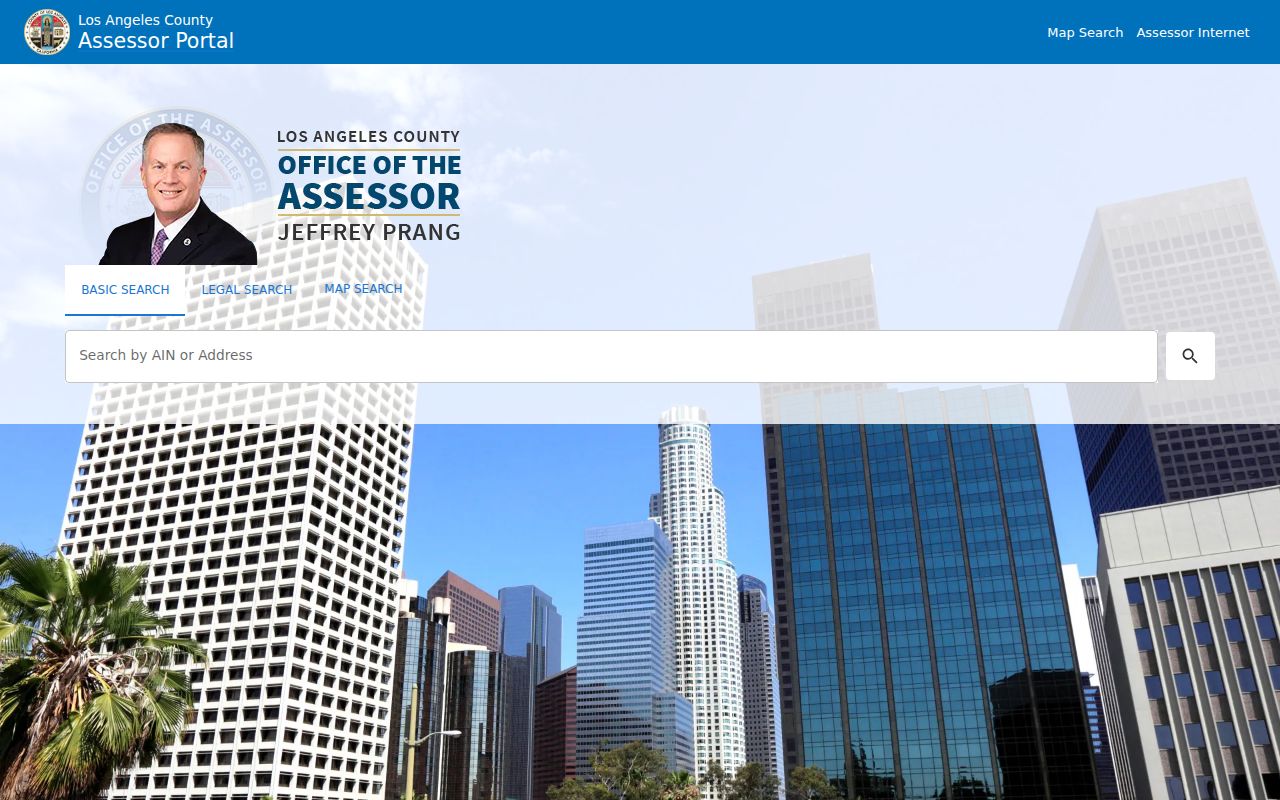
The field pattern shows exactly what the web tool accepts and nothing more. Jot down the AIN, situs, and parcel details first. Then call the Assessor or visit a district counter to ask about ownership through this city directory channel.
| Basic Search / Legal Search | Tabs; optional alternate search modes. |
|---|---|
| Search by AIN or Address | Autocomplete text; one value required; use a ten-digit AIN or street address. |
| Map Search | Map control; optional; zoom, pan, and select a parcel. |
Owner questions that cannot wait for the web can go through the Assessor's Specific Property contact route at 888-807-2111 or 213-974-3211, at a district counter, or by giving staff the AIN or address. A separate AIN-based service returns tax payment history for the last three fiscal years, though it does not identify a resident. A county map can help with adjacency, but Bell is incorporated, so unincorporated-county zoning layers are not Bell zoning.
Bell Voter Status Is Self-Only
The California My Voter Status lookup checks one person's own record. It is not a public Bell name-and-address browser for a resident lookup. After an identity match, it shows registration status and location, party preference, language preference, polling details, and vote-by-mail or provisional standing for that person alone.
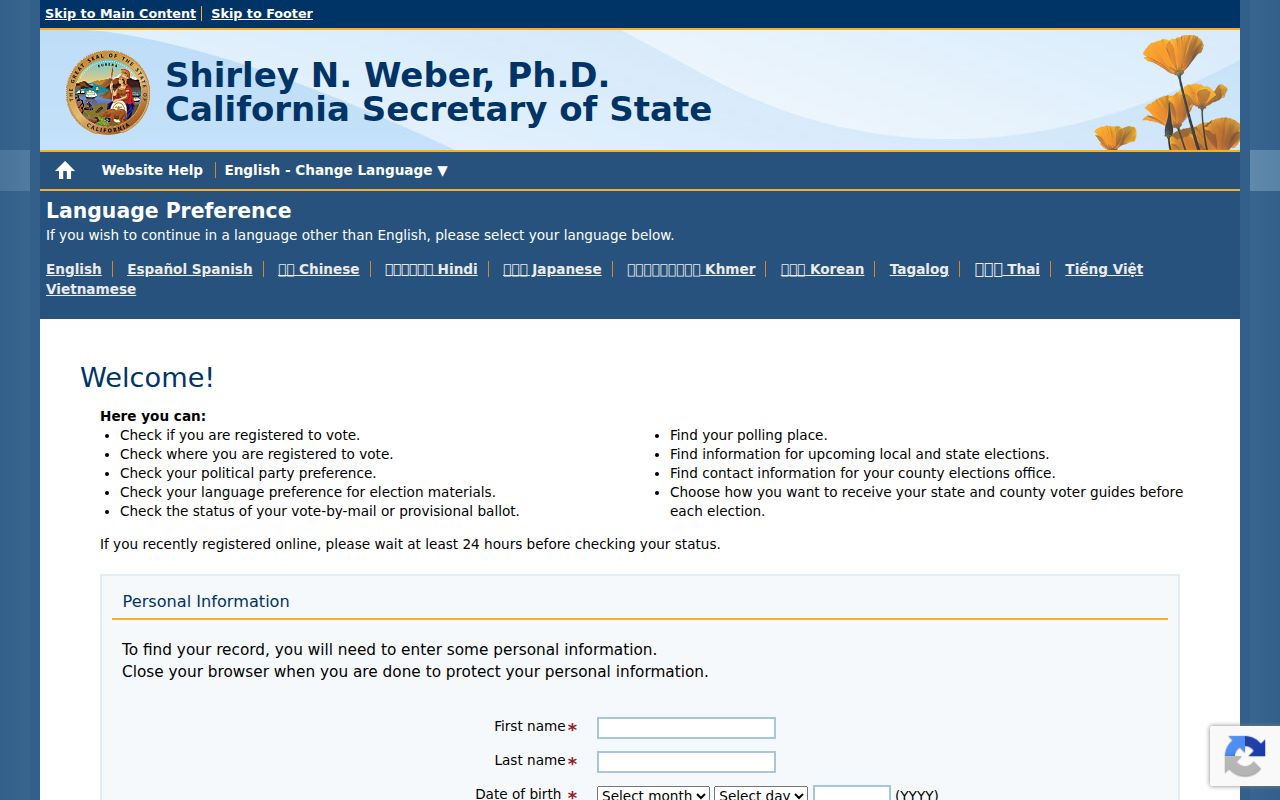
The identity requirements explain the limit. No street search can be built from this voter rolls tool.
- First name and last name
- Required text fields for an exact personal match.
- Date of birth
- Required month, day, and year controls.
- California DL or ID number
- Conditional exact-match field, with a checkbox when none is available.
- SSN last four
- Conditional exact-match field, with a checkbox when none is available.
County requests run through a separate channel. LA County charges $1.50 for a certified copy of your own registration. Another authorized or public copy costs $6.75. Voter history runs $6.75 per name, and a file search is $5 per name. Mail the Election Information Section at 12400 Imperial Highway, Room 2013, Norwalk, CA 90650, with requester name, address, birth date, signature, telephone, and a self-addressed stamped envelope. The office lists 800-815-2666 option 4 and voterinfo@rrcc.lacounty.gov. Bulk files need purpose declarations, with separate countywide, precinct, district, and city fees. Historic Bell poll-book years are still an open question.
Los Angeles Court and Vital Records
Court and vital records sit in different systems. The Los Angeles Superior Court Find a Case route gives free case-number access but charges for party or defendant-name searching. Bell matters go through the county court system, though the filing location varies by case type. Coverage is reported from 1983 for family, probate, and unlimited civil cases, from 1991 for limited civil, and from 1992 for small claims. Public terminals and the Archives and Records Center remain fallback channels. Criminal and family documents are not available remotely, and juvenile, sealed, and adoption records are restricted.
Vital records take a different path. LA County RR/CC holds county birth records since 1866 and death records since 1877, with county request routes for birth, death, marriage, and death-record inspection. For the statewide route, California's Department of Public Health vital-records overview lays it out. Authorized and informational copies serve different uses under Health and Safety Code section 103526, confidential marriage copies stay restricted, and a divorce decree belongs to the court while the state issues only a certificate of record. California applies no simple 100-year birth or 50-year death opening rule.
Fees differ by channel. County copies cost $34 for birth, $26 for death, and $19 for marriage. The 2026 state fees are $31, $26, and $19 for those categories, and state processing often takes weeks. County in-person and mail channels can move faster for a Bell event, though eligibility and identity rules still control release.
Bell City Clerk Record Requests
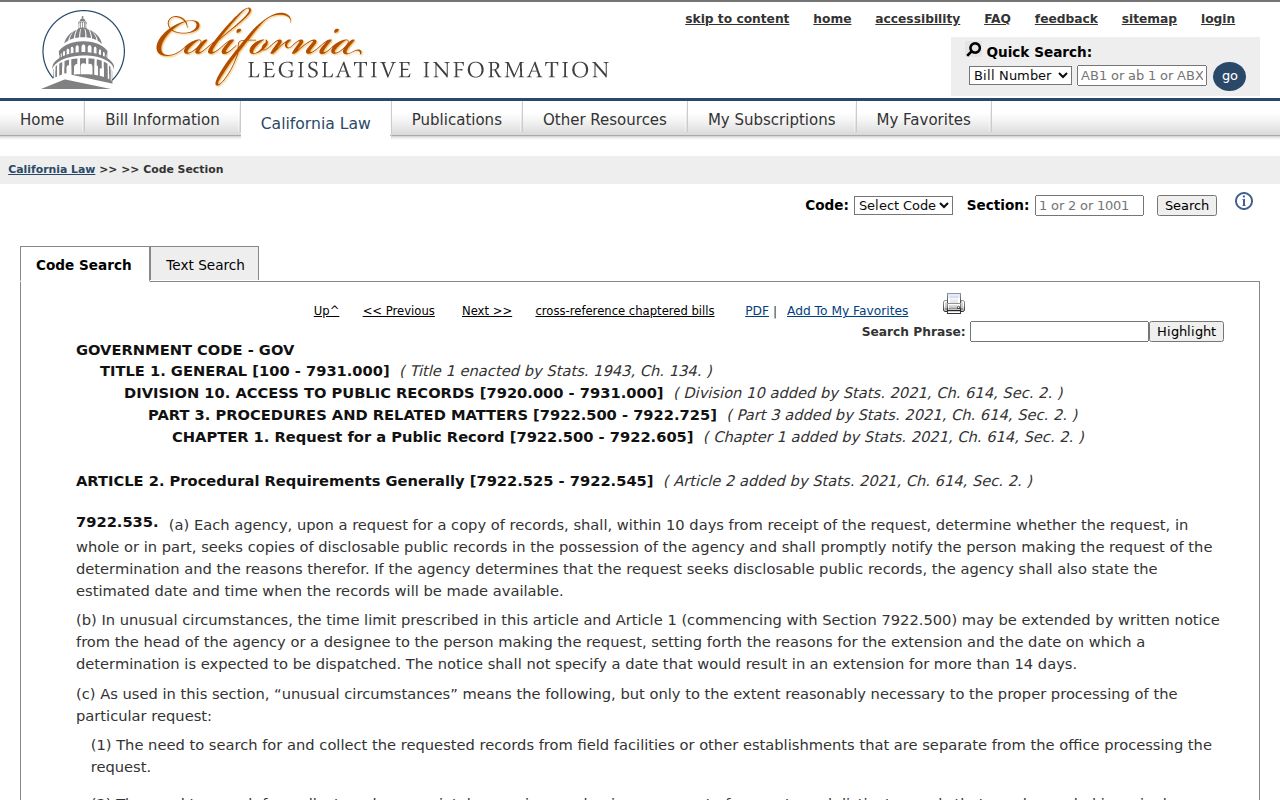
The California Public Records Act opens nonexempt state and local records to anyone. Under the statutory determination rule, an agency has ten calendar days to decide whether responsive records can be disclosed, plus a possible written fourteen-day extension for unusual circumstances. That clock sets the determination, not the delivery. Production may follow on its own schedule.
The Bell CPRA request form asks for a name, mailing address, email, and telephone. It also wants a reasonable description of the records, optional comments, and a CAPTCHA. Anything submitted after 5 p.m., on a weekend, or on a holiday counts as received the next business day. The Laserfiche City Records Portal posts selected PDFs. The Clerk will help when its categories or search fields are unclear.
For permits, plans, and inspection history, Building and Safety takes questions by address. Include an AIN or date span if you can. Use 323-588-6211 extension 2611 and psanchez@cityofbell.gov. Code Enforcement answers focused questions at extension 2618 and rarriola@cityofbell.gov. Walk-ins are welcome, and appointments are encouraged. The OpenGov permit page offers no confirmed public search. The Bell Police report form and fee remain unclear. A narrow Clerk request is safer than counting on an online result.
What Bell Parcels Can Prove
A parcel record proves real things. It can establish a physical location, an AIN, assessment traits, mapped neighbors, and sometimes a recorded ownership connection. It cannot prove that the owner lives there. It cannot prove that every household member appears. It also cannot prove that a mailing address is visible online. Keep situs, mailing address, legal description, deed party, and occupant as separate facts.
A careful Bell trail runs in steps. Go from address to AIN, and from AIN to an offline owner request. Go from owner to an RR/CC name-and-year search. Go from deed legal description to confirm the same land across time. Tax payment history adds recent parcel context for the last three fiscal years. A permit or code case can show an applicant, owner, contractor, inspection, or project date. It is not residency proof.
Official Rolls and Commercial Compilations
Official records in Bell and Los Angeles County come with named custodians. They also carry clear search keys and checkable limits. That structure is what makes a record trustworthy. Commercial compilations lack it.
A paid database can still serve as a first clue. It may point you toward a Bell residents directory search. But these products lag behind county offices. They merge neighbors who share a name. They sometimes recycle a past address as if it were current. They never replace the source office's own voter rolls or property rolls.
No commercial service can open a restricted voter file for you. It cannot open a protected vital record either. The official record always outranks the copy.
| Question | Official record trail | Commercial compilation |
|---|---|---|
| Who controls the record? | Bell, LA County, California, court, library, or archive custodian | Private data compiler with its own update cycle |
| What is the search key? | Address/AIN, party and year, case number, or authenticated personal fields | Mixed names, addresses, and public or purchased data |
| What can confirm a match? | Legal description, filing date, household, or custodian-issued copy | Possible lead only; same-name and stale-address risk |
| Best use | Verify a parcel, civic file, family-history clue, or recorded event | Decide which official custodian to contact next |
In Bell, the official route usually moves slower. The deed index sits office-only, and the voter lookup requires personal authentication.
That friction serves a purpose. It keeps a resident lookup tied to the record's actual function, and it gives you a custodian who can fix an error rather than a vendor who cannot.
Historical Bell Resident Directories
Bell Library at 4357 E Gage Avenue anchors local history research. Staff answer by phone and in person. They offer photocopying, and they post weekday hours of 10:00 a.m. to 6:00 p.m. A renovation or Express Library notice can change access, so call first. The full historical question belongs on the Bell city directory research path. It does not belong on any assumed list of years.
LA County Library's Californiana Collection sits in closed stacks at Norwalk Library, 12350 Imperial Highway. It holds more than 24,000 books. It also holds over 200 newspaper and magazine titles in paper and microfilm. Staff can search the catalog, Digital Collections, and BiblioBoard. They can then pull items from the closed shelves. The collection lists no Bell-specific city directory publisher. It lists no year run, criss-cross series, telephone-book run, obituary index, or yearbook holding.
That gap matters. Los Angeles volumes from 1915 or 1916 cannot simply be relabeled as Bell directories. Ask Bell Library or Norwalk staff to verify a title page. Ask them to check its local coverage before quoting any year or publisher. A directory entry establishes a historical address lead, never ownership.
Bell's 1950 Census and 1922 Sanborn
The 1950 Census is the newest federal population snapshot open to the public. For family history, it matters most. The 1960 count follows in 2032 under the 72-year rule. Census pages can reveal household relationships, an address, and occupation clues. NARA Riverside serves as the Southern California fallback for census, immigration, naturalization, and military records. Bell Library helps connect a local name to a regional volume.
The Library of Congress record for the May 1922 Bell and Maywood Sanborn collection covers the map set. It identifies 20 sheets. Those sheets show whether a structure existed. They show how it was used, and where it sat in the older built landscape. They do not name past residents. Pair the map with an exact census address. Add a verified directory page, and the county deed legal description.
Bell's record-keeping follows a local rhythm. County library service began in 1913. The Sanborn map dates to 1922, and Bell incorporated on November 7, 1927. Pre-incorporation research therefore leans on county, townsite, deed, census, and library records. Bell municipal permits are not the answer for that era.
90201 and Bell's City Boundary
90201 is the only standard Bell ZIP code, and it reaches beyond the city. Its delivery area covers large parts of Bell Gardens and Cudahy. The Bell Gardens post office sits at 7001 Garfield Avenue. The Cudahy facility sits at 4619 Elizabeth Street. A ZIP code directory can validate a mailing clue. But it cannot tell you which city custodian holds the record.
The numbers make the point. The 90201 ZCTA counted 95,810 people in 2020. Bell itself held roughly 31,930 people around 2024. Those figures describe different geographies. Bell spans about 2.81 square miles across Central City and the Cheli industrial area. The Los Angeles River and I-710 tie those zones together. Delivery city, municipal line, and record jurisdiction can all diverge.
No Bell portal offers a ZIP-wide resident search. The Assessor works from an address or AIN. Map tools take an address, AIN, or intersection. RR/CC searches by name and year. The county publishes no ZIP split, PO-box-only code, street renumbering, or E911 assignment procedure for Bell.
Privacy Around Bell Resident Records
California gives residents several ways to limit exposure of personal records. The DROP request system launched January 1, 2026. Registered data brokers began processing requests August 1 on rolling 45-day deletion cycles. Submit one verified request, keep the confirmation, and check again later. A public-looking compilation is not always current.
Safe at Home serves qualified survivors and threatened participants. It provides a substitute mailing address, mail forwarding, an agent for service, and confidential voting. It is not witness protection, and it does not erase identity. Government Code sections 6205-6216 govern the program. Section 6209.5 allows substitute use on qualifying real-property documents. Recorded images also carry statutory redaction rules for Social Security numbers.
Public record does not mean unrestricted reuse. Voter fields, motor-vehicle data, vital copies, and recorded documents each follow separate rules. Keep any Bell residents directory search tied to family history. Use it for civic verification or a focused records request.
Lawful use. Do not use a Bell record trail to stalk, harass, intimidate, or publish identifying details to cause unwanted contact. Voter-file misuse and knowing electronic harassment can carry legal consequences, so stop and contact the custodian when a record is protected or unclear.
When Bell's Official Trail Ends
When the official trail goes cold, narrow the ask instead of guessing a name. Suppose Laserfiche holds no city file you need. Then a CPRA request can describe the record precisely. Give the address, the AIN, the department, and the date span. Want a permit or code history? Ask Building and Safety or Code Enforcement directly for whatever address evidence they can release. Deed questions work differently at the Norwalk recorder. Bring party names and years, because staff there cannot search by street.
Some gaps in the Bell residents directory picture stay open. The exact city-directory and criss-cross years remain unclear. So does a verified telephone-book run. So do a sample deed-index entry and historic poll-book years. A digitized yearbook holding is unclear too. The police report form and fee also remain unknown. The Bell Library, Norwalk Californiana, the RR/CC, and the City Clerk are the right places to press those questions. A commercial compilation or a neighboring city's record should never fill the blank.
The strongest Bell residents directory result is a chain, not a roster. Each link states what the source proves and where it stops. A parcel leads to an AIN. An owner request leads to deed names. A court or vital event leads to an eligible copy. A census or directory lead ends in a corroborated household. That discipline keeps Bell and Los Angeles County records genuinely useful. It does so without turning partial public files into an invented list.